
GLA London Plan Energy Statement
Walker Energy Analysis prepares GLA energy statements for major developments across Greater London, following the London Plan’s energy hierarchy and the GLA’s own Energy Assessment Guidance. The statement has to demonstrate how the scheme reduces its carbon emissions at each stage of the hierarchy, and it’s assessed on its own specific structure, separate from any borough or non-London planning policy.
The Energy Hierarchy
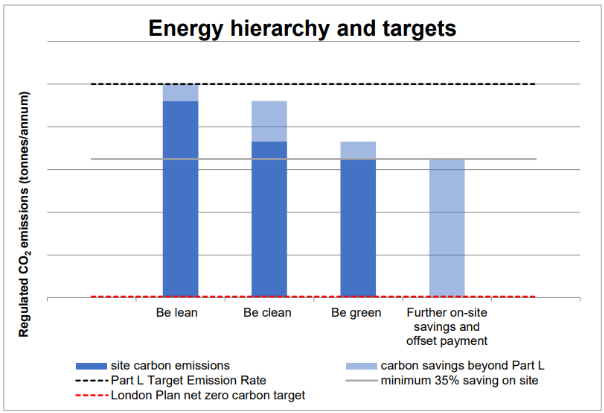
The GLA requires major developments to work through four stages, each one demonstrating a further reduction in carbon emissions against the Part L baseline for the building.
Be lean: reducing energy demand through fabric efficiency, airtightness and thermal bridging, before any equipment or renewables are considered.
Be clean: specifying efficient heating and cooling systems, and considering connection to a local heat network where one exists or is planned.
Be green: incorporating renewable technologies, solar PV, heat pumps and similar, to meet the borough’s renewable energy contribution.
Be seen: committing to monitor and report actual energy performance for five years after completion, compared against what was predicted at design stage.
Major developments are expected to achieve at least a 35% reduction in on-site regulated carbon emissions beyond Part L, and where that target can’t be fully met on site, the shortfall is paid as a cash-in-lieu contribution into the borough’s carbon offset fund.
- Part L baseline modelling, SAP for residential, SBEM or dynamic simulation for commercial and larger buildings
- Be lean, be clean, be green assessment through the full energy hierarchy
- Enhanced modelling using CIBSE TM54 to support the be seen reporting stage
- Energy Use Intensity and space heating demand reporting, alongside the regulated carbon figures
- A statement structured to the GLA’s own template, ready for submission through your borough
Does Your Project Need One?
A GLA energy statement is generally required for major developments, typically 10 or more dwellings, or non-residential schemes over 1,000 square metres, though some boroughs set additional requirements below this threshold. Larger schemes, above 150 homes or 30,000 square metres, are also referable directly to the GLA rather than assessed solely by the borough. We’ll confirm early whether your project meets the threshold and what your specific borough expects on top of the core GLA requirements.
Why Work With Us
We’re a specialist energy consultancy. This is the core of what we do, not a sideline. Every assessment runs through IES VE as standard, we turn changes around quickly, and results come back in a format your team, the borough, and the GLA can use immediately.
FAQs
Q: What’s the difference between a GLA energy statement and a standard local authority energy statement?
A: The GLA statement follows a specific, prescribed structure and energy hierarchy set out in the London Plan and GLA guidance, with its own carbon reduction target and reporting requirements. Local authorities outside London each set their own separate policy, which can look quite different.
Q: Do I need TM54 modelling for a GLA submission?
A: Enhanced dynamic modelling, following the TM54 methodology, supports the be seen stage of the hierarchy and is generally expected for major developments alongside the standard Part L-based assessment.
Q: What happens if my scheme can’t reach the 35% on-site reduction target?
A: Once on-site reductions have been maximised and evidenced, the remaining shortfall is paid as a cash-in-lieu contribution into the relevant borough’s carbon offset fund.
Q: What’s the five-year monitoring commitment?
A: Major developments are expected to report actual energy consumption data for five years after completion, through the GLA’s monitoring platform, so performance can be compared against what was predicted at design stage..
Get Your GLA Energy Statement in Place
Talk to Walker Energy Analysis early, and get your energy hierarchy assessment right before it becomes a planning delay.
Does your project need something else?